
In this Q&A, Amariah Gibbs, the Clean Ports Program Manager at the Utah Division of Air Quality (DAQ), discusses the benefits and challenges of fleet electrification—as well as how DAQ is helping businesses make the switch.
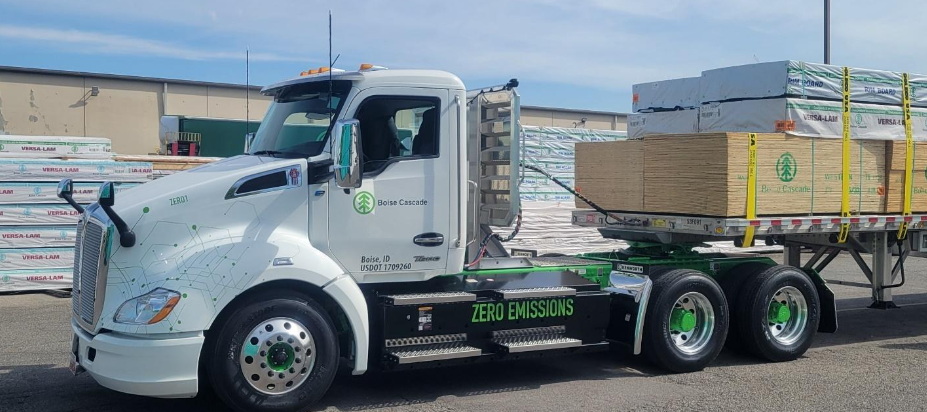
Electric truck funded through a previous Utah Division of Air Quality grant program.
- What is your role with Utah’s Clean Ports Program?
As DAQ’s Clean Ports Program Manager, I serve as a liaison between fleet owners, community stakeholders, and national resources to improve Utah’s air quality through port electrification. The Clean Ports Program provides funding and other support to electrify vehicles and cargo-handling equipment at the Salt Lake City Intermodal Terminal (SLCIT), a freight hub owned and operated by the Union Pacific Railroad Company (UP). I am working with UP to assess vehicle and equipment purchasing plans to progress the infrastructure needed to complete Phase 1 of their fleet electrification transition. Additionally, I am preparing to launch an application for electrification incentives in Quarter 1, 2026. Once this application opens, qualified drayage truck companies accessing the SLCIT will be able to apply to receive funding to cover between 75 and 90 percent of the cost of a new electric drayage truck. - What is an electric vehicle (EV) and what benefits do EVs provide?
An electric vehicle (EV) is a vehicle powered by an electric motor and a large battery instead of a gasoline or diesel engine. Because they don’t burn fuel to move, EVs have zero tailpipe emissions, meaning they do not produce exhaust, smoke, or carbon dioxide. Many of us are familiar with passenger EVs, but the Clean Ports Program focuses on electrifying heavy-duty trucks and cargo handling vehicles to eliminate greenhouse gases and conventional pollutants. This beneficial transition provides cleaner air for local communities and lower operating costs for businesses. Electric vehicles will create new jobs that support construction and maintenance of chargers. The Clean Ports Program will support this growth by funding workforce training and the essential charging infrastructure required for Utah’s zero-emission future. - What are some of the factors that a business might consider when thinking about electrifying a fleet?
Electrifying a fleet is a big decision that requires careful planning but can offer significant advantages. Here is what businesses need to weigh during the transition:
Key Considerations
-Equipment: The durability and price of available electric equipment.
-Infrastructure: The investment required to support charging equipment.
-Workforce: The training needed to make this transition.
Potential Benefits
-Lower Operational Costs: EVs generally have lower fuel and maintenance costs.
-Worker Health & Well-Being: Reduced stress and health impacts, as EVs are quieter and do not produce tailpipe emissions.
-Reputation: The reputational and community benefits of electrification.
DAQ and other similar entities offer incentive programs and other resources for electrifying your fleet. For instance, I support the necessary utility coordination for these upgrades, while other entities like Utah Clean Energy offer fleet evaluations and recommendations for electric adoption based on specific business operations. - Why does UDAQ offer incentives for electric and cleaner vehicles?
Vehicle emissions are the main cause of air pollution along Utah’s Wasatch Front. Even though electrification offers substantial long-term benefits to both businesses and communities, the short-term transition can be challenging because of EVs’ higher startup costs compared to their gas and diesel counterparts. The price gap between electric and gas-powered passenger vehicles has narrowed in recent years but a large electric truck can still cost two or even three times as much as a diesel truck. DAQ offers incentives to jumpstart the deployment of zero-emission equipment, effectively lowering the financial barriers that often deter businesses from trying new technologies. We enable fleet operators to bypass initial financial hurdles by reimbursing up to 90% of the cost of a new electric truck for the Clean Ports Program. This increases access to the economic benefits of electrification while improving Utah’s air quality. DAQ’s Clean Fleet Program also provides funding for fleet owners to replace older Class 5-8 diesel vehicles and equipment with cleaner alternatives. - How can someone find out what incentives they might qualify for?
To receive an alert the moment grant applications go live, please sign up for the DAQ Clean Fleet and Air Quality Grant email updates.